New Focus, New Beginnings

Pastor David Neuen – Lead Pastor, dneuen@pumc.org

At my yearly eye examination, the optometrist inquired whether I had noticed any change in my ability to read small print. “No doctor, all is looking clear,” I replied. Then enter the busy season of Christmas preparations and I found myself squinting into my tablet trying to make out the fuzzy characters. “How much must I zoom in this screen to make this thing legible?!?” Wrapping and labeling presents, I wasn’t sure whose name I was scribbling on the tags. I have lived with severe nearsightedness since my teenage years but this struggle with close vision was a new, uninvited obstacle. But nothing to be alarmed by says the eye doctor when evaluating my aging eyes. Some of you perusing this article through your readers know the experience. While incredible technology through laser surgery has proven effective to remedy many types of visual refractive errors, not all blurry vision can be fixed.

“Fixing my eyes” is a practice I wish to pursue in this New Year. No, I have not committed to Lasik surgery. But I do endeavor to reorient my focus on the revealing and revelation of Jesus. How might we experience this year differently if we wake up each morning to fix our eyes upon Jesus?

One opening to seeing differently is accomplished by identifying experiences of new life and restoration. Rather than focusing on our litany of problems, we can reinterpret our experiences to see where the Spirit is healing, reuniting, and presenting new opportunities. Perhaps you and I can begin a journal where we record these glimpses of heaven meeting earth, where God is at work amidst the mess that threatens to discourage.

Fixing our eyes also takes the intentional effort of naming areas in our life where the Spirit of Christ seeks growth. Perhaps we should be asking what spiritual practices, routines and roles needs to be reworked this year to stretch our adherence and witness to God. How might our priorities and investment of energy and resources shift to better align with our passion to follow Jesus?

Fixing your eyes upon Jesus is a practice of altering the atmosphere around you. What rhythms of breathing, prayer, reading, or making of music might move you from an environment of nervousness to peace? How can we see the day with gladness and joy as a blank slate for exciting interactions, opportunities to speak encouragement, and occurrences for love?

While I need to find myself a nice pair of reading glasses, I will also be praying to the Lord of all direction and comfort, “Be thou my vision!” And I’m praying for your beautiful new year in which you may see all things with the eyes of Christ.

And Who Is My Neighbor?

Larry Rudy – Plainfield UMC Member

Happy New Year, PUMC! 

I am praying your Advent and Christmas have been blessed by moments of realizing how very near and present God is to you, to each person who lives and breathes, to all of Creation! We are so loved. 

For many of us, our faith is of great importance – it is our very life, our knowing God, our getting to know Jesus through the work of the Holy Spirit. Our church is very important to us – it is the community that helps us grow in our faith, serve others as Jesus taught us and with whom we worship, study, reach to others and share fellowship. Some questions around these important facets of our life together have come to my attention as of late. What difference does being part of a church make in our life, in the lives of others? Where is God in all of it? 

To help us better answer those questions this year I’ll be sharing this space with…you! Throughout 2025 you will find here the stories of lay people exploring the many facets of life as a disciple of Jesus. I pray they will both encourage and challenge you, as they do me!

Rev. Abby Lietz
Associate Pastor

And Who Is My Neighbor?

by Larry Rudy

This fall we concluded the all-church study “Short Stories by Jesus.”  In response to the lawyer’s provocative question and his attempt to redefine who qualifies as his neighbor, Jesus tells the parable of the Good Samaritan. Jesus makes it clear in this parable our neighbor is anyone around us, no matter their ethnic, religious or socio-economic status. 

It was about one year ago the Presbyterian Church near my home became the Sikh Gurdwara Shaheed Akali Baba Phula Singh Ji.  I was pleased to see the church property finally occupied, but just who were our new neighbors? A gurdwara, as I looked up, is a place of assembly and worship in Sikhism. I also noticed they left in place the Presbyterian church sign statement, “GOD IS GOOD ALL THE TIME.” 

In the months that followed their arrival, I observed frequent daily activity and large numbers of cars filling their parking lot. This past fall my interest in “my neighbor” peaked as, passing by, I saw two workmen very active on a project at the entrance of their Gurdwara. 

In late October I harvested a bumper crop of canna lily rhizomes, so I took two grocery sacks full with me to meet my neighbor! Hi neighbor! My name is Larry. Would you like to have some canna lily rhizomes for your garden? I found the two workmen did not speak English well, but we were soon joined by a fellow named Surinda who welcomed me graciously and offered me delicious hot tea with milk. We exchanged pleasantries, and Surinda answered several questions I asked about the Sikh religion. He then gave me a tour of the Gurdwara. Shoes were removed at the entry and a cover wrap placed on my head.   Surinda explained this was in reverence for being in a holy place of worship. I noticed the Sikhs had no furniture for sitting, no pews in their large prayer room. Every room was lushly carpeted for worship as well as for eating. Worshipers come and go throughout the day and food is always available. I met two ladies who prepare all the meals.  They smiled but spoke no English.

I was invited to attend their “Festival of Lights” celebration two days later, Diwali.  I did not know anything about Diwali, but Surinda explained it was like our New Year’s Eve, a celebration of coming out of darkness into light. That sounded very good to me and I accepted his invitation to arrive at 6:30pm.  In the meantime I did some research on Diwali and Sikh history to prepare.  

I arrived on time, removed my shoes at the entry and struggled to secure the head covering until assisted by someone who was also entering. I did not see Surinda but followed a line to the central room where there was a buffet of food ready. Everyone was dressed in traditional Indian/Pakistani garb with men wearing turban headwear and full beards. I saw no Sikhs greeting visitors like me, but met a Plainfield policeman on duty for security.  I followed the officer through the food  line, sampling each item prepared, without any idea what it was!

After the meal I entered into what used to be the sanctuary of the old church. Music was played and there was singing in a language foreign to me.  I sat with others on the outside wall and observed.  Worshippers entered and proceeded to an altar where they knelt in a prostrated position for prayers.  After a short time of observance, I quietly left the building.

I had only been in the Gurdwara for about 45 minutes and never saw my host, Surinda. I returned home having met my neighbor, rewarded by the welcome, but without the feeling of acceptance in the sharing of Diwali.  

We might consider my singular experience at the Sikh Gurdwara if the role was reversed. What do visitors to Plainfield United Methodist Church experience when they enter?  Are we open to accepting those who may be different from us in  ethnicity, race, sexual identity, social sophistication or language? Do we venture to meet those we do not know on a Sunday morning, or only speak to those we call close friends? In our daily living, are we willing to risk our discomfort to reach out to someone who is unlike ourselves to become more neighborly? Who might we seek to connect with this year, who might we learn from as we reach beyond ourselves?

I believe the question of “who is my neighbor” leaves much for each of us to think about.

The Nativity Scene: Then and Now

Pastor David Neuen – Lead Pastor, dneuen@pumc.org

Inspired by his travels to the Holy Land, Saint Francis of Assisi created the first live nativity scene in 1223 to help children understand the true meaning of Christmas. The friar wanted to portray the birth of the holy child in a way that people might remember Christ’s humility and poverty. He showed the onlookers that the holy can be found outside the physical structure of the church. Crowds gathered holding candles and torches at a cliff side in Greccio, a small town 50 miles north of Rome, to see the reenactment of the manger with Jesus, Mary and Joseph alongside live animals. The story goes that the onlookers experienced a miracle, seeing a real infant appear in the empty manger with St. Francis taking the beautiful child into his arms, holding him in a loving embrace.

In the late 15th century, brothers Pietro and Giovanni Alamanno began creating life-size sculptures of religious figures for display in local chapels. This included creating the scene of Christ’s birth. A Christmas creche craze had begun. Soon, small-scale nativity scenes became a popular collector’s item among the wealthy. In 1567, the duchess of a small town in Italy commissioned more than 100 crèche figurines for display in her home, including camels carrying treasure, dogs, an elephant, and a giraffe.

Emerging in the 16th century, the Protestant branch of the church took issue with nativity scenes, rejecting and destroying them as materialistic distractions. Figurines of baby Jesus were called out as idolatrous icons distracting from a personal relationship with the living Christ. But hostility towards the nativity scene softened. Some Protestant Christians settling in the Americas brought nativity figures with them as domestic decorations. When Christmas became celebrated as a national US holiday in the mid-19th century, the popularity of nativity sets grew tremendously.

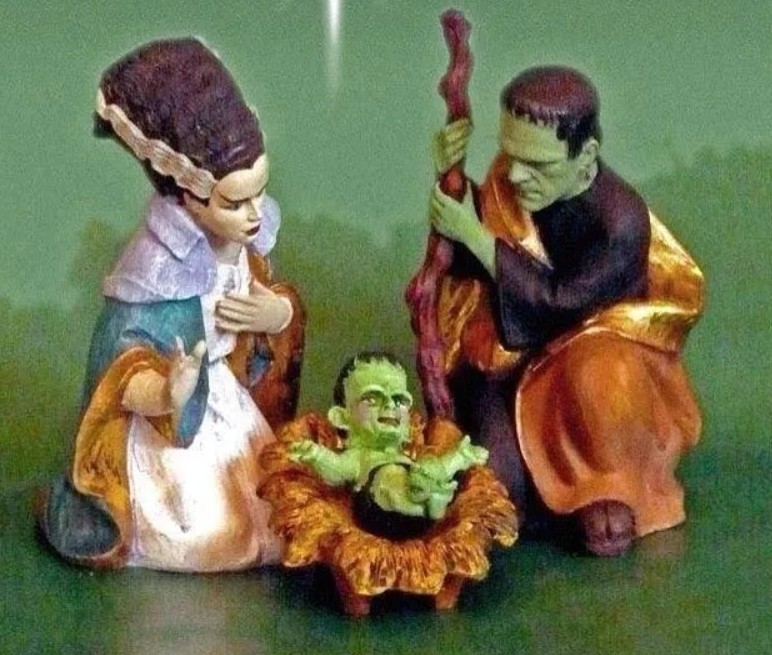
Today, artists have pushed the boundaries in merging the nativity scene with cutesy or current characters. Relevant Magazine reveals what they consider to be “17 Very Theologically Questionable Nativity Scenes You Can Own.” When Jesus and his earthly parents are represented by gnomes, ducks, woodland creatures, or Frankenstein, we might be missing God’s gracious revealing in coming to dwell with us, like us.

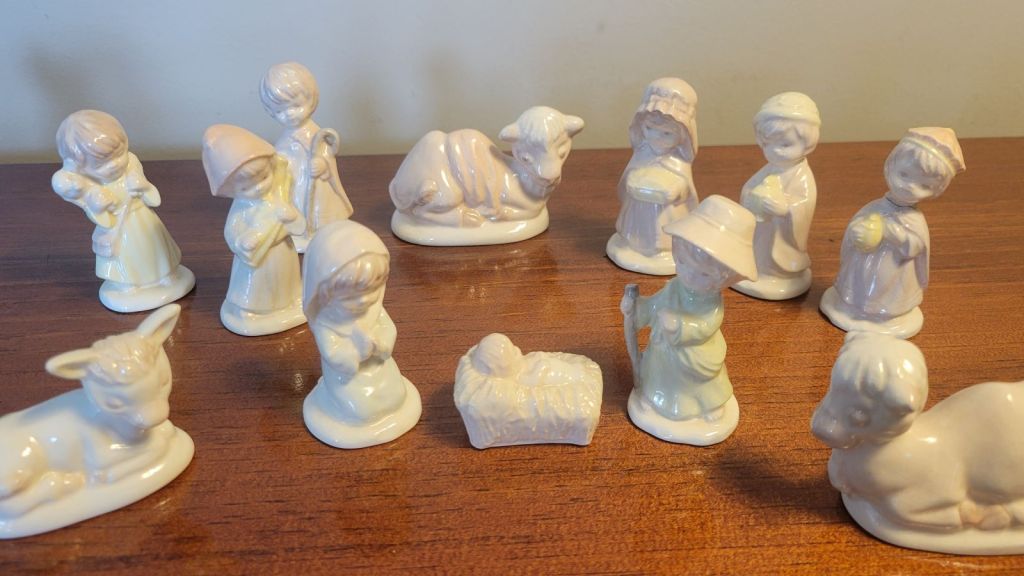
Through the years our family has collected a number of nativity sets for display in our home. One holds significance because it was hand painted by my grandmother. Another olive wood carved creche was purchased in Israel. They each remind me of the presence of Christ known in the giftedness and kindness of the artist that made them. They also capture my eyes, directing me to God’s self-giving in the form of a humble child. I see God’s loving nature, God’s willingness to stoop down into hardship and discomfort. I glimpse the first to worship Jesus beaconing my praise. I spy an angel reminding me of God’s intention to continue sending messages of assurance, renewal, and call. And I chuckle at the sight of a camel, a cow, and some sheep, pointing me to God’s beautiful creation which also reveals God’s holiness.

Do you own a nativity scene? What stories does it tell about God and about you? Enjoy the moments to see again the miracle of Christ’s birth and the gift of God’s miraculous love. Merry Christmas!

Reflect, Reconnect, Renew 2025

Pastor Abby Lietz – Associate Pastor, alietz@pumc.org

Today is a beautiful fall day – the clouds are grey, there are still pumpkins on porches and a bit of color on the trees here and there. We are in a season of gratitude as Thanksgiving approaches, at least it was at the time of my writing, and in a season of preparation: Advent will have begun by the time you read this, the season in the church we prepare our hearts and homes to welcome Jesus once again. We have also seen another United States presidential election, and a general election that saw Indiana consider candidates for governor, lieutenant governor, attorney general and more – all the way down to our town councils and school boards. I’m admittedly still processing the outcomes and what they say about the state of our nation, what the role of the Church and we as Jesus followers play in all this. It’s the end of 2024; 2025 is fast approaching. In the past year we said goodbye to one senior pastor and hello to a new, we had lots of staff shuffles and even more are on the way with the retirement of our youth pastor next summer. Our General Conference of the UMC met last spring and opened the way for gay clergy to be ordained and gay couples to be married by our pastors in our places of worship. We received a new bishop in Indiana! I got married and moved farther away from you than I wish I was. Via the Worship Annex, we are launching something new this month – the beginning of what I am certain will birth incredible ministry and sharing the love of God with others. There is a lot I could say about any of these moments, these decisions and how they impact us and will continue to impact, inform and guide us in the days, weeks and months to come.

But what I want to share with you is encouragement, some reminders, some challenges to take up for the year ahead. I am convinced, now more than ever, our institutions are not going to save us, that our stuff is not going to save us, nor our money or our health or anything. We have Jesus, God and the Holy Spirit, we have ourselves, we have each other and this beautiful Earth. How, in 2025, can you connect more deeply with these four areas – your own Self, Creation, your fellow human beings and God? What do you need to cut out of your life or give up or take up in order to connect, to reconnect? What do you need to dive into? Ease into? What must you walk away from? Who must you listen to? Don’t forget – trees are people, too!

I mean this seriously: it matters how we live. And we can talk all day about ideas over coffee, but I wonder what practices can help us stay connected. What can we do to stay grounded, to heal, to create more capacity to love and forgive ourselves and others? So we can ask ourselves: Are we worshiping God with every part of our lives? Where else do we need to surrender to God? Where else can we serve some aspect of the Earth or other humans who are not us and our immediate household? How can we live more joyfully and peacefully with ourselves, each other and God? These are good reflection questions to ask so when 2025 arrives we are ready to live, at least a bit more fully, the lifestyle Jesus modeled when he was alive and the one he calls us to live yet today. One that bears life-giving fruit.

Dallas Goldtooth, a Native American environmental activist and performance artist recently shared ways people can organize themselves in their community. He listed things like:

  • Create a local group where you can share ideas and create support for people who need help
  • Get together with crafty people to craft and learn to craft and be in fellowship
  • Join a radical read book club where you read books often banned or that push you into new territory for thinking and serving in the community
  • Make art – radical art – like public art, theater, and zines. Make music! Play it! Read poetry in public!
  • Join or start a community garden
  • Start a community fridge or a clothing pickup point, or a sanitary products giveaway
  • Volunteer with a cause you care about
  • Get to know your neighbors

As the church, we are great at coming up with these kinds of efforts but if you’re like me, maybe you need a fresh start. I hope we can be about even more intentional connection this year – the kind of efforts and connections that don’t burn us out, but instead fill us up with the love and assurance that we are loved by God and empowered to make a real difference in the world around us by the way we live, by the way we speak and forgive and love. It’s going to be OK in 2025. God is already making a way for us – I’ll see you there!